
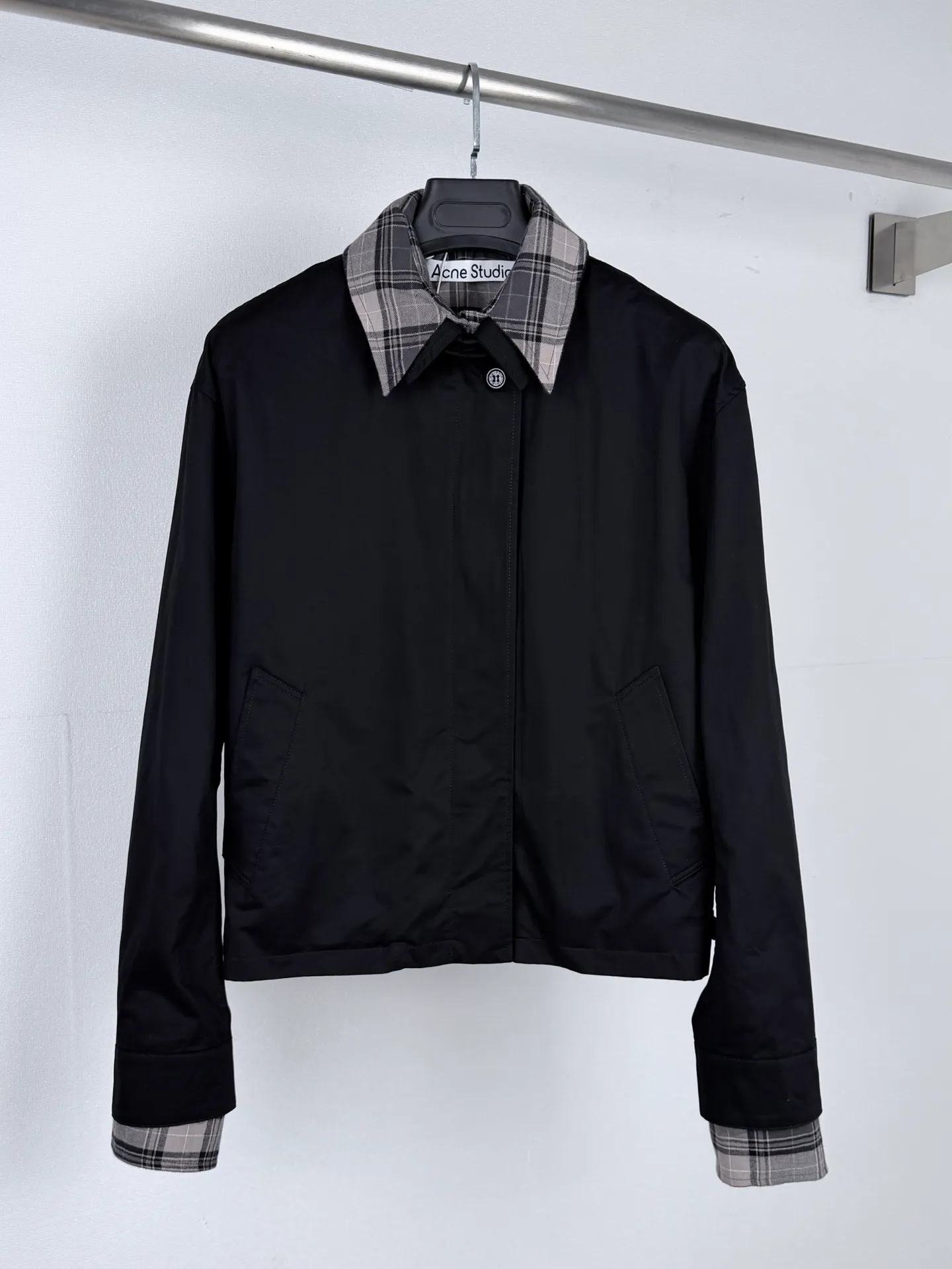
ACNE Studios black plaid collar fake two-piece short lapel jacket relies on double-layer cutting to create the visual effect of layering shirts. The difference in fabric properties and the superposition of multiple splicing points make the entire production process have a high process threshold and a very low production error tolerance rate. The main body of the garment is made of washed twill woven fabric, and the splicing parts are matched with Retro plaid fabric. The two types of fabrics have different weights and shrinkage rates, and pre-shrinking and shaping processes must be performed separately before production. If the fabric pre-treatment is not in place, the shrinkage of the two fabrics will be inconsistent after the garment is completed, and the spliced seams will easily appear to be pulled, wrinkled, and twisted. The lapel is composed of a solid color base fabric and a plaid pattern. During the sewing process, it is necessary to continuously balance the tension of the two layers of fabrics and strictly control the collar angle arc to ensure that the left and right collar shapes are symmetrical and upright, and to prevent blistering and folding and misalignment of the collar surface. The checkered cuff cuffs are made of independent split pieces. The direction of the checkered pattern is calibrated during the cutting stage. The textures on the left and right cuffs are in the same position, and the splicing horizontal lines are consistent to maintain a coordinated appearance. The front panel adopts a hidden placket structure, with multiple layers of overlapping stitching and obvious thickness differences. The sewing pressure and stitch length are dynamically adjusted during sewing to avoid problems such as skipped stitches and wavy seams. Adjustment tab components are configured on both sides of the hem, and the positioning accuracy of the small auxiliary pieces is stringent. The diagonal pocket adopts embedded technology, and the bag fabric is seamlessly connected with the body without destroying the simple lines of the body. The vertical dividing line of the garment body is precisely aligned up and down to ensure the square shape of the short box-shaped silhouette and prevent the left and right asymmetry of the garment and the height deviation of the hem. Difficulties such as splicing different materials, multi-layer composite sewing, and alignment of plaid parts are superimposed on each other. Improper tension control in any process will weaken the natural texture of two fake pieces. From fabric pre-treatment, precise cutting, layered precision sewing, to low-temperature flexible ironing and shaping, the process chain is complicated, testing the lathe craftsmanship and the factory's refined quality control capabilities, and clearly reflecting the manufacturing process barriers of light luxury garments. Size:36 38 40 42
ACNE Studios black plaid collar fake two-piece short lapel jacket relies on double-layer cutting to create the visual ef...
ACNE Studios black plaid collar fake two-piece short lapel jacket relies on double-layer cutting to create the visual effect of layering shirts. The difference in fabric properties and the superposition of multiple splicing points make the entire production process have a high process threshold and a very low production error tolerance rate. The main body of the garment is made of washed twill woven fabric, and the splicing parts are matched with Retro plaid fabric. The two types of fabrics have different weights and shrinkage rates, and pre-shrinking and shaping processes must be performed separately before production. If the fabric pre-treatment is not in place, the shrinkage of the two fabrics will be inconsistent after the garment is completed, and the spliced seams will easily appear to be pulled, wrinkled, and twisted. The lapel is composed of a solid color base fabric and a plaid pattern. During the sewing process, it is necessary to continuously balance the tension of the two layers of fabrics and strictly control the collar angle arc to ensure that the left and right collar shapes are symmetrical and upright, and to prevent blistering and folding and misalignment of the collar surface. The checkered cuff cuffs are made of independent split pieces. The direction of the checkered pattern is calibrated during the cutting stage. The textures on the left and right cuffs are in the same position, and the splicing horizontal lines are consistent to maintain a coordinated appearance. The front panel adopts a hidden placket structure, with multiple layers of overlapping stitching and obvious thickness differences. The sewing pressure and stitch length are dynamically adjusted during sewing to avoid problems such as skipped stitches and wavy seams. Adjustment tab components are configured on both sides of the hem, and the positioning accuracy of the small auxiliary pieces is stringent. The diagonal pocket adopts embedded technology, and the bag fabric is seamlessly connected with the body without destroying the simple lines of the body. The vertical dividing line of the garment body is precisely aligned up and down to ensure the square shape of the short box-shaped silhouette and prevent the left and right asymmetry of the garment and the height deviation of the hem. Difficulties such as splicing different materials, multi-layer composite sewing, and alignment of plaid parts are superimposed on each other. Improper tension control in any process will weaken the natural texture of two fake pieces. From fabric pre-treatment, precise cutting, layered precision sewing, to low-temperature flexible ironing and shaping, the process chain is complicated, testing the lathe craftsmanship and the factory's refined quality control capabilities, and clearly reflecting the manufacturing process barriers of light luxury garments. Size:36 38 40 42
2026-10-24